Sealock is a dry bag manufacturer and wholesale supplier. For a distributor, capacity is not a technical question — it's an inventory decision. Dry bags are one of the few outdoor products sold almost purely on litres, which means the sizes you stock determine your sell-through, how much cash sits in slow rungs of the ladder, and whether a customer finds the bag they came in for. This guide covers which capacities actually move, how deep to go on each, and the packing and labelling details that catch wholesale buyers out.
A day's layers and essentials — kayaking, fishing, cycling
Core volume seller
15–20L
Change of clothes plus food; rafting, boating, light overnight
The hero size — the most versatile in the range
30–40L
Multi-day loads, group gear, bulkier kit
Strong second tier, higher ticket
60–100L
Expedition, raft cargo, basecamp hauling
Specialist — low turn, high ticket
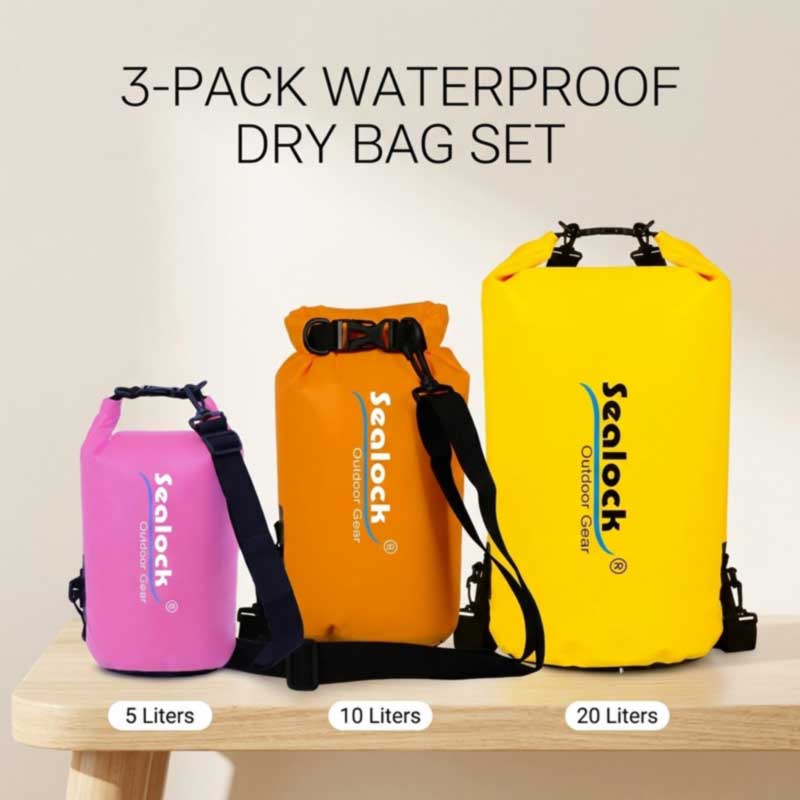
Two figures are worth holding onto when planning an order. Across the wider market, the 20–40L band accounts for roughly 80% of international wholesale demand — it's the balance point between retail popularity, real usability, and material cost. And if you stock only three sizes, the trio the category has settled on is 5L, 10L, and 20L, which is also the standard retail three-pack.
Breadth fills a shelf; the mix decides what actually sells.
Building the Size Mix
Anchor on 20L — the most versatile size and the one shoppers search for most. Deepest stock, widest colour choice.
Make 10L the second pillar — day-trip buyers convert quickly and it's an easy second purchase.
Carry 30–40L properly — this is the other half of the 80% band, not a tail size. Multi-day and group buyers pay more per unit.
Keep 2–5L shallow but always present — low ticket, but it drives add-on sales at the till and fills multipacks.
Order 60L+ to demand — high ticket, low turn, and the bulkiest to store and ship.
Multipacks: The Format That Carries This Category
Assorted multipacks are among the strongest sellers in dry bags, and for a real reason rather than a merchandising trick: paddlers and campers genuinely pack modularly — one sack for clothing, one for the sleeping bag, one for wet gear. A set answers how people actually use the product.
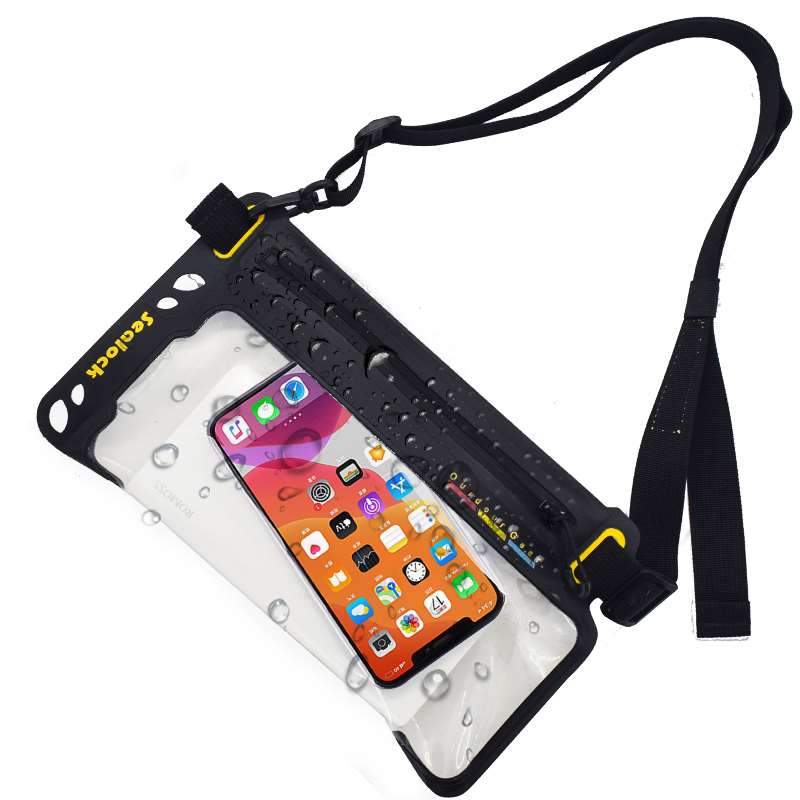
For a wholesale buyer the advantages compound: one SKU instead of three, a single price point, no need to predict which single size a shopper wants, and a higher average order value than any individual bag. The proven bundle is a small-medium-large trio — 5L, 10L, and 20L, in coordinated or contrasting colours. Two variants worth considering: a 2L+5L+10L set aimed at valuables and organisation, and a bundled phone pouch, which is one of the most-cited bonus features in the category and turns a bag into a complete kit.
Colour Is a Capacity Decision Too
Colour does more work here than in most categories, because dry bags are used as an organisation system. Colour-coding by size lets a paddler identify contents inside a hatch or a pack without opening anything — which is exactly why multipacks are sold in contrasting colours. Commercially:
High-visibility colours — yellow, orange, red — sell into water sports, where a dropped bag needs finding.
Black and grey — understated, corporate, and promotional orders.
Depth beats breadth — several colours in 10L and 20L generally outperforms a wide size ladder in one colour.
Five, ten, twenty — the trio that matches how people actually pack.
The Labelling Trap: Stated vs Usable Capacity
This is the most common source of complaints in the category, and it is entirely avoidable. A roll-top's usable volume depends on how many times it is rolled: sealing consumes roughly 15–20 cm of vertical fabric, about 4–5 cm per fold, which reduces real capacity by around 4–6L compared with the unrolled state. A 20L bag correctly sealed does not hold twenty litres of gear.
Two practical consequences for a wholesale buyer:
State it in your listing copy. Explaining that volume varies with the number of rolls heads off returns before they happen, and reputable brands do exactly this.
Advise customers to size up. Overfilling is the leading cause of "my dry bag leaked" — a stuffed bag has no slack left to fold three or four times, so the seal never forms. Printing the closure instruction on the product and packaging prevents more negative reviews than any specification upgrade.
Freight: The Capacity Advantage Buyers Overlook
Dry bags are light but bulky, so freight is normally charged on volumetric rather than actual weight. There is, however, a genuine advantage in this category: tube dry bags nest. Smaller sizes pack inside larger ones, which can materially improve carton efficiency on a mixed-size order compared with shipping each size separately. Points to confirm at quotation:
Carton quantity per size — this drives your per-unit freight more than the unit price does at the large end.
Whether sizes can be nested or packed together for a mixed order.
Packing format — individual polybag plus master carton is standard.
Origin — a China or Vietnam base can change landed cost depending on your tariff schedule.
How MOQ splits across sizes and colours — this decides how wide an assortment a first order can cover.
The Product Basis
These welded bags, from Sealock's dry bag line, are equal options for a wholesale assortment — none is ranked above another; several span an entire ladder within one model, which is the efficient way to build a range:
Image
Model & specs
Wholesale role
MOQ
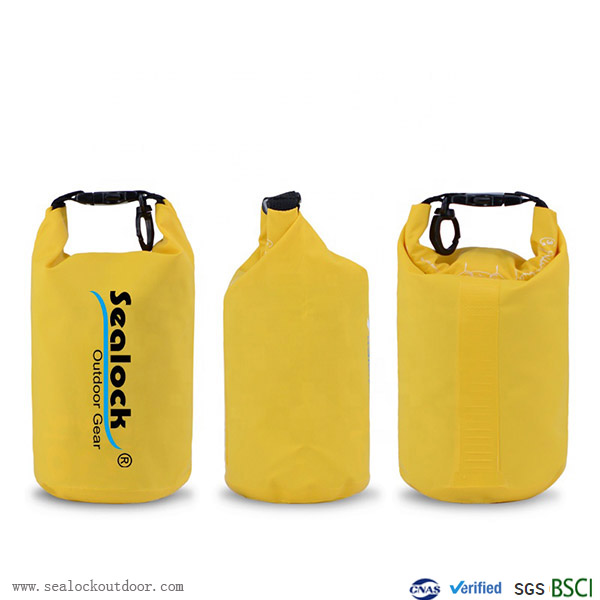
SL-D069 Dry Bag (full size ladder) — 5/10/15/20/30/40/50/60/80/100L with published dimensions per size, from D15.5×H45 cm to D36×H115 cm; 500D PVC mesh; eight colours; sample 7–10 days.
Ten capacities in one model — an entire assortment from one pattern
The core trio plus 30L — ready-made three-pack sizes
500
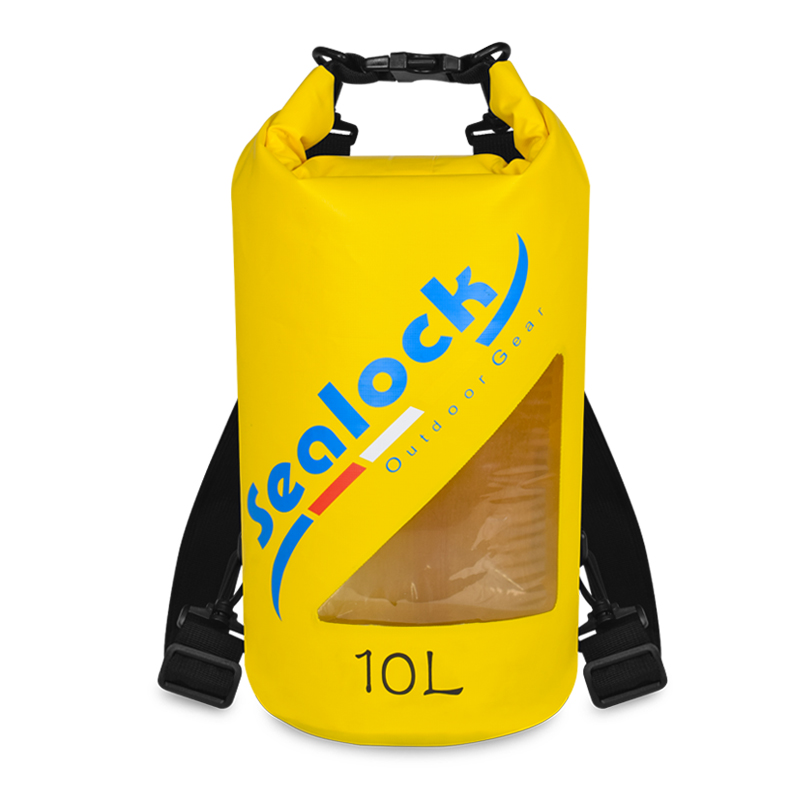
SL-D110 Dry Bag with Window — 2/5/10/15/20/30/40/60/80L; 500D PVC tarpaulin; transparent window so contents are visible; eight colours; supply 10,000 pcs/month.
Nine capacities with a visible upgrade feature
500
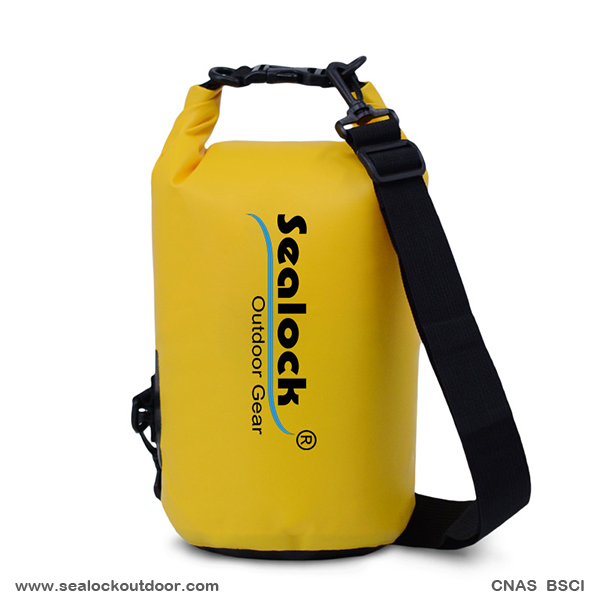
SL-D051 2L Dry Tube Bag — 500D PVC tarpaulin 0.50 mm; black, blue, yellow, red; fold-seal with back-up Velcro; REACH, EN71, Bureau Veritas; small quantities accepted.
The add-on and multipack filler; strong promotional item
500
SL-D054 Tube Dry Bag — 5/10/12/15/20/25L; PVC & TPU tarpaulin; six colours; supply 10,000 pcs/month.
Mid-band focus, available in either material for two price points
500
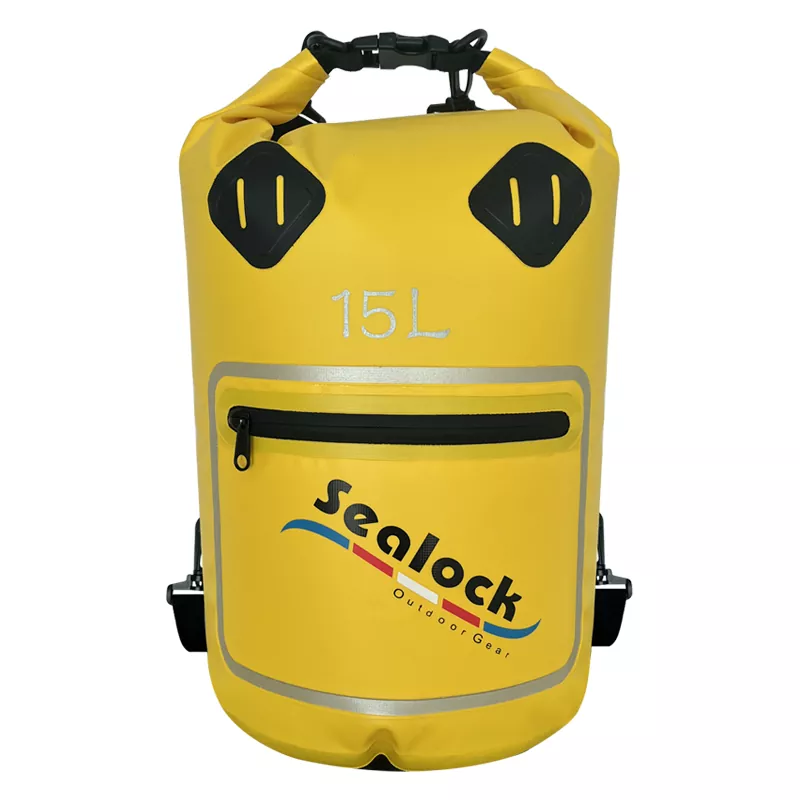
SL-D693 Tube Dry Bag with Window & Zip Pocket — 15L (53×36 cm) / 20L (57×38 cm); 500D PVC tarpaulin; IPX7; transparent window; dry-wet separation; floats; POM buckle; yellow, black.
Premium tier in the hero sizes — a higher price point on the best-selling band
300
The SL-D069 makes the planning point neatly: ten capacities from 5L to 100L on one pattern, with published dimensions per size, so a buyer can build a full ladder without committing to several separate models. Capacity, colourway, material and branding are all specifiable; material trade-offs are covered in our dry bag material guide: tpu vs pvc.
Quality Consistency Across an Assortment
An assortment only works if the 5L performs like the 60L. Quality is gated in three tiers — IQC (incoming tarpaulin, buckles and webbing against the signed colour card, with colour difference and fastness, which matters most when one colourway runs across ten sizes), IPQC (cutting tolerance, weld integrity and strap-anchor assembly, with peel tests on sample welds at each run start), and OQC (AQL sampling, a real water-submersion batch test, and gold-sample comparison, with SGS or QIMA inspection available). Sealock also strictly executes the complete customer inspection procedure on finished goods: unboxing, vacuum extraction, a 24-hour static rest, and air-leak determination. The lab additionally runs weld bond and peel strength, a 1,500+ cycle load test with jerk-loading on strap anchors and buckles, abrasion, tear, tensile, salt spray, UV, colour fastness and colour difference.
FAQ: Wholesale Capacity Planning
Q: If I stock only three sizes, which should they be?
A: 5L, 10L and 20L. That trio covers valuables, day use, and the versatile all-rounder, and it's also the standard retail three-pack, so the same stock serves both single and bundled sales.
Q: Which band carries the most wholesale demand?
A: 20–40L, which accounts for roughly 80% of international orders. Don't treat 30–40L as a tail size — it's the second half of the core band and carries a higher ticket.
Q: Why do customers say the bag is smaller than advertised?
A: Because sealing a roll-top consumes 15–20 cm of fabric — roughly 4–6L of usable volume against the flat-state figure. State it in your listing and advise sizing up; it prevents returns.
Q: Are multipacks worth stocking?
A: Usually yes. Campers and paddlers pack modularly, so a 5/10/20L set matches real use, lifts average order value, and reduces the guesswork of predicting a single size. Bundling a phone pouch is a frequently praised addition.
Q: More sizes or more colours?
A: Depth of colour in the sizes that move — 10L and 20L — generally beats a wide ladder in a single colour. Bright colours sell into water sports; black and grey suit corporate and promotional orders.
Q: How is the MOQ applied across sizes and colours?
A: MOQ is set per model, from 200 pieces on some and typically 300–500. How it splits across capacities and colours is confirmed at quotation, so tell us the assortment you're planning and we'll quote against it.
Talk to the Factory
For wholesale quotations, assortment planning, and samples across the capacity range, contact Sealock at info@sealock.com.hk or +86-769-82009361. Over twenty years of high-frequency welding, ladders running from 2L to 100L, a China–Vietnam dual-base option, and a full customer inspection procedure on every shipment.
Biz sizə daha yaxşı baxış təcrübəsi təklif etmək, sayt trafikini təhlil etmək və məzmunu fərdiləşdirmək üçün kukilərdən istifadə edirik. Bu saytdan istifadə etməklə siz kukilərdən istifadəmizlə razılaşırsınız.
Məxfilik Siyasəti
 English
  Español
  Português
  русский
  Français
  日本語
日本語  Deutsch
  tiếng Việt
  Italiano
  Nederlands
  ภาษาไทย
  Polski
  Svenska
  magyar
  Malay
Malay  বাংলা ভাষার
  Dansk
Dansk  Suomi
Suomi  हिन्दी
  Pilipino
  한국어
한국어  Türkçe
  Gaeilge
  العربية
  Indonesia
  Norsk
Norsk  تمل
تمل  český
český  ελληνικά
  український
  Javanese
  فارسی
فارسی  தமிழ்
தமிழ்  తెలుగు
  नेपाली
  Burmese
  български
  ລາວ
ລາວ  Latine
  Қазақша
  Euskal
  Azərbaycan
  Slovenský jazyk
  Македонски
  Lietuvos
  Eesti Keel
  Română
  Slovenski
  मराठी
मराठी  Srpski језик